AKUMAJŌ DRACULA
( Castlevania )
|
|
|
|
|
悪魔城ドラキュラ
©Konami 1986
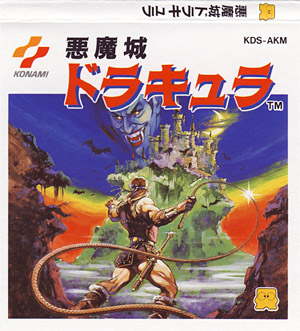
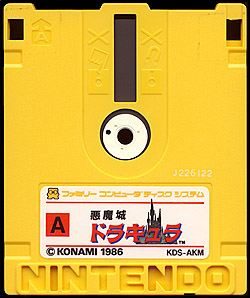
Release: 1986-09-26 (¥2980)
DiskCard KDS-AKM
Action/Platform game
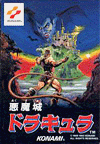

|
Released in Japan (Cartridge) as
AKUMAJŌ DRACULA
( RV003 )
|
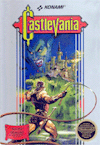

|
Released in America as
CASTLEVANIA
( NES-CV-USA )
|
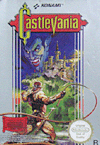

|
Released in Europe as
CASTLEVANIA
( NEC-CV-XXX )
|
|
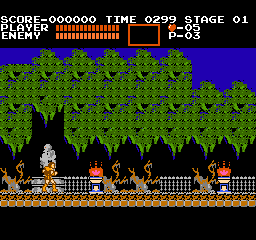
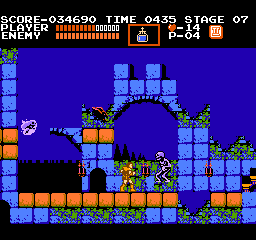
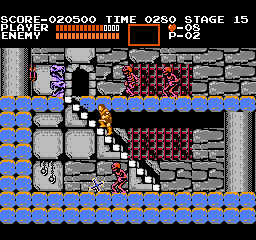
Akumajō Dracula is a side scrolling action game by Konami and the
first opus from the critically acclaimed and celebrated video game
saga known in the west as Castlevania. Every hundred years,
a legend proclaims that Count Dracula and his minions will rise
from the dead and will bring chaos and death to the land of Transylvania.
And one hundred years ago, the prophecy fulfilled and Dracula was
resurrected by his worshippers, but was stopped by the legendary vampire
hunter Christopher Blemont. One hundred years has passed and
Count Dracula returned to Transylvania once again. This time,
Simon Belmont from the Belmont bloodline of vampire killers,
takes up the challenge. Armed with his mythic and legendary whip, he begins his
journey to the Prince of Darkness's castle. Dracula's lair is
guarded by legions of demonic vampire bats, zombies, fish men, ravens, skeletons and
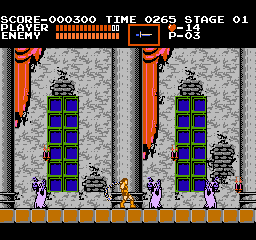
other undead creatures. In addition to his trusty whip, Simon can pick up
secondary weapons by breaking candles and other elements of the scenery (usually walls).
These weapons range from the Stop watch (stops enemy's action), the Dagger
(fast throwing weapon), the Axe (slow but powerful overhead attack weapon),
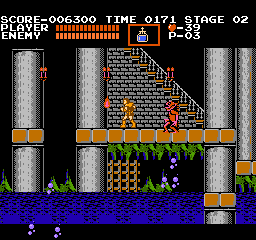
the Cross, the Holy Water and so forth. The vampire killer can only carry one
of these lethal weapons at the time and they all come in limited quantities - they can
however be replenished by collecting little hearts scattered throughout the
game. Other items are also available to help
Simon in his quest, such as Crosses or Invisibility Potions, and
two special items are particularly worth mentioning - the double and
triple shots enable Simon to fire two or three special weapons
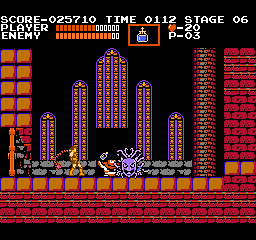
at once! Each stage ends with an obligatory boss Simon must take down
before advancing to the next level - they range from the mythological
Medusa to Death himself who appears as a creepy Grim Reaper.
Akumajō Dracula consists of six large areas and is single-player only.
|
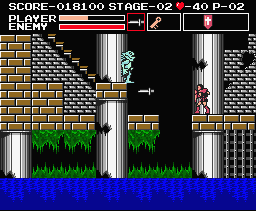 Although Akumajō Dracula for the Famicom Disk apparently hit the shelves first,
a MSX-2 version was also released in Japan on October 1986 (picture on the right),
and was also released in Europe under the name
Vampire Killer. This MSX version is rather interesting - the graphics are
a lot sharper than the Famicom version and both games share a lot in common.
However, the game's structure is very different - for instance keys must be found to
unlock doors and chests and shops are actually scattered throughout the game where
the player can purchase weapons and items using hearts, the game's currency. Additionally, and unlike the
Famicom version, secondary weapons come with unlimited ammo.
Anyway, back to the Famicom version - it was released later in the US (1987) and Europe (1988) in
cartridge format. The western versions are fairly close
to the original Famicom Disk game and only a couple of items' names were
edited - the Holy Water became a less controversial Fire Bomb and
the Cross made out of stakes became a Boomerang. However, there is
another major difference - the
original Famicom Disk game had a save feature which gave players the ability to save their progress,
and this option was entirely removed from the western version...
This is, I think, fascinating - Akumajō Dracula is
Although Akumajō Dracula for the Famicom Disk apparently hit the shelves first,
a MSX-2 version was also released in Japan on October 1986 (picture on the right),
and was also released in Europe under the name
Vampire Killer. This MSX version is rather interesting - the graphics are
a lot sharper than the Famicom version and both games share a lot in common.
However, the game's structure is very different - for instance keys must be found to
unlock doors and chests and shops are actually scattered throughout the game where
the player can purchase weapons and items using hearts, the game's currency. Additionally, and unlike the
Famicom version, secondary weapons come with unlimited ammo.
Anyway, back to the Famicom version - it was released later in the US (1987) and Europe (1988) in
cartridge format. The western versions are fairly close
to the original Famicom Disk game and only a couple of items' names were
edited - the Holy Water became a less controversial Fire Bomb and
the Cross made out of stakes became a Boomerang. However, there is
another major difference - the
original Famicom Disk game had a save feature which gave players the ability to save their progress,
and this option was entirely removed from the western version...
This is, I think, fascinating - Akumajō Dracula is
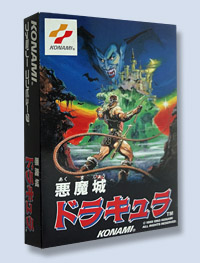 notorious for its incredible difficulty level, but the original Famicom Disk,
thanks to its save-feature, is a lot less frustrating to play overall. Why didn't Konami include
a save features using a password system like Metroid? Especially for a game that
was initially designed and ultimately tuned up with a save-feature in mind?...
The game was also ported to several home systems of the time such as the
Commodore 64 (1990), Amiga (1990) and PC (1990).
Additionally, Konami re-released Akumajō Dracula in Japan for the Famicom on
cartridge in 1993 (picture on the left) - this version
is much harder to find than the original
Famicom Disk game and a lot more expensive today. Interestingly this
version also didn't have the save feature from the original Famicom Disk
release, however Konami kindly included an additional
'easy mode' which greatly improves the game's playability in my opinion.
Another version worth mentioning is VS.Castlevania, an arcade port for the
Nintendo VS. System. Despite its name, the game is still single-player and
is fairly identical to the Famicom version for one notable change - the
difficulty level was dramatically increased and the game is incredibly challenging.
Finally, Akumajō Dracula was also part of the Classic Nes Series for
the Game Boy Advance released in 2004.
notorious for its incredible difficulty level, but the original Famicom Disk,
thanks to its save-feature, is a lot less frustrating to play overall. Why didn't Konami include
a save features using a password system like Metroid? Especially for a game that
was initially designed and ultimately tuned up with a save-feature in mind?...
The game was also ported to several home systems of the time such as the
Commodore 64 (1990), Amiga (1990) and PC (1990).
Additionally, Konami re-released Akumajō Dracula in Japan for the Famicom on
cartridge in 1993 (picture on the left) - this version
is much harder to find than the original
Famicom Disk game and a lot more expensive today. Interestingly this
version also didn't have the save feature from the original Famicom Disk
release, however Konami kindly included an additional
'easy mode' which greatly improves the game's playability in my opinion.
Another version worth mentioning is VS.Castlevania, an arcade port for the
Nintendo VS. System. Despite its name, the game is still single-player and
is fairly identical to the Famicom version for one notable change - the
difficulty level was dramatically increased and the game is incredibly challenging.
Finally, Akumajō Dracula was also part of the Classic Nes Series for
the Game Boy Advance released in 2004.
|
Teaser text from the American version:
Enter At Your Own Risk!
If you think it's scary on the
outside, wait'll you see the basement.
You're in for the longest night
of your time. Ghosts, goblins,
demons, wolves, bats - creatures
lurking around every corner. As you
descend deeper and deeper,
they get thicker and thicker.
Better stick close to the cavern
floor - it's your only chance of
finding a weapon or two. You're
gonna need'em.
Because when you
finally meet the Count,
you know he'll be going
for the jugular. So keep your
courage up and your stake
sharp. And say your prayers.
|
Game Staff (Copied from the end credits) :
|
Produced by
KONAMI
Directed by
Trans Fishers
Screenplay by
Vram Stoker
Music by
James Banana
|
|
The Cast
Dracula
Christopher Bee
Death
Belo Lugosi
Frankenstein
Boris Karloffice
Mummy Man
Love Chaney Jr.
Medusa
Barber Sherry
|
|
Vampire Bat
Mix Schrecks
Hunch Back
Love Chaney
Fish Man
Green Stranger
Armor
Cafebar Read
Skeleton
Andre Moral
|
|
Zombie
Jone Candies
And the Hero
Simon Belmondo
Hairdow
You played the
greatest role
in this story
Thank You
For Playing
|
|
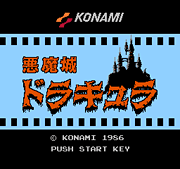 I don't usually add a section about the game's credits, but Akumajō Dracula
does need some explanation. All the staff's names are actual puns giving homage
to classic horror stories and especially old horror movies. Anyone curious would have
noticed that the title screen shows the edges of a film reel (picture on the right) which
was a first homage to the game's roots and original inspirations. As mentionned, all the names
in the credits are references to classic writers and directors,
such as Terence Fisher (movie director of classics
such as Dracula, Frankeinstein or The mummy), Bram
Stoker (author of the original Dracula novel), James Bernard
(music composer of the classic movie Dracula), and actors such
as Christopher Lee (who played Count Dracula in Terence's
Dracula in 1958) and Bela Lugosi (who played Count Dracula
in the original Dracula movie in 1931). I leave to you to decipher the
other names from the game's end credits!
I don't usually add a section about the game's credits, but Akumajō Dracula
does need some explanation. All the staff's names are actual puns giving homage
to classic horror stories and especially old horror movies. Anyone curious would have
noticed that the title screen shows the edges of a film reel (picture on the right) which
was a first homage to the game's roots and original inspirations. As mentionned, all the names
in the credits are references to classic writers and directors,
such as Terence Fisher (movie director of classics
such as Dracula, Frankeinstein or The mummy), Bram
Stoker (author of the original Dracula novel), James Bernard
(music composer of the classic movie Dracula), and actors such
as Christopher Lee (who played Count Dracula in Terence's
Dracula in 1958) and Bela Lugosi (who played Count Dracula
in the original Dracula movie in 1931). I leave to you to decipher the
other names from the game's end credits!
If all the names from the credits are puns and pseudonyms, then who are the
real people behind Akumajō Dracula? The game was apparently directed by
Hitoshi Akamatsu (although it is hard to confirm) and the iconic music was written
by Japanese video game music composers Kinuyo Yamashita (it was
her first work at Konami and she also composed the soundtrack
of other Famicom games such as Arumana no Kiseki,
Majō Densetsu II Daimashikyō Galious and Moero Twinbee).
|
G
O
O
D
I
E
S
|
|
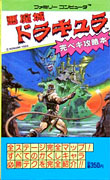
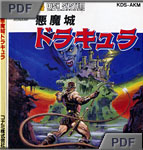
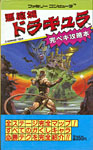
Japanese guide book
|
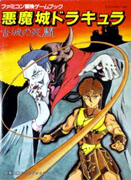
Japanese story book
|
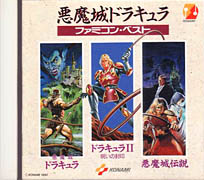
Japanese soundtrack
|
|
|
O
M
A
K
E
|
|
|
|
|
Click on picture to enlarge |
|
|
|
LK

|
|
Add your Pov here !
|
P
O
V
s
|
|
The first thing that stroke me upon playing Akumajō Dracula
for the Famicom Disk system was the music - right from the first
minutes of play, the outstanding and familiar melody of the opening level
sets the tone which tickles anyone with a nostalgic bone. After the pleasure comes
the pain. Akumajō Dracula is a great example of tough 8-bit love -
the stiff controls lead to countless cheap deaths and Simon's weak
jump gets him to often miss platforms and fall into bottomless pits with
distressing ease. Bosses are also of the worst kind and patience is
a vital virtue in Simon's success. Graphics look overall aged and
some of the levels are blocky and the color palette sorely lacks clarity
in some occasions (although the contrast between sprites and background graphics is
exquisite and really well thought out). But if you put Akumajō Dracula back in its
original context, you get a true classic filled with the same spirit
that was poured onto its numerous sequels. A piece of video game
history that will bring genuine tears of nostalgic joy to the old school players
among us, and tears of equally suffering pain to the others.
|
|
|
|